If you’ve ever driven along a rural highway at dawn, watching the guardrail posts rise like quiet sentinels against the horizon, you know how unassuming they are—until you don’t. I’ve been a guardrail posts supplier for 12 years, and let me tell you, I’ve seen the worst of what these steel (or composite) structures take on: snow plows scraping their sides, deer slamming into them at 50 mph, years of salt and freeze-thaw cycles that turn a solid post into something brittle, prone to splitting or corroding through. For decades, the fix has been reactive: replace a post after it fails, patch a rusted section, hope the next impact doesn’t take out an entire stretch of guardrail. But lately, the question I’ve been fielding more than any other is this: Are there any guardrail posts with self-healing properties? Guardrail Posts
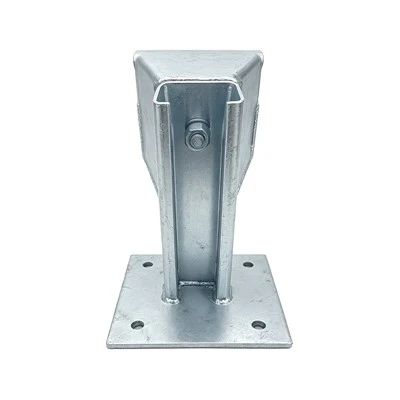
It’s a fair question. When you think about self-healing materials, you don’t usually think of a 6-foot steel post buried 3 feet in the dirt. You think of phone screens that fix their own scratches, or concrete roads that seal their own cracks. But for a supplier who’s spent years iterating on post designs, the answer isn’t a hard yes or no—It’s a work in progress, one that’s already moving past lab tests and into real-world deployments, and it’s changing the game for safety and maintenance.
Let’s start with what “self-healing” actually means in the context of guardrail posts, because that’s where a lot of the confusion starts. A lot of people hear “self-healing” and picture a post that can magically bend back into shape after a 10,000-pound truck slams into it. That’s not what we’re talking about here. For guardrail posts, self-healing breaks down into two core, practical categories: corrosion self-healing, which stops small rust spots before they turn into structural failures, and crack/seam self-healing, which seals tiny fissures caused by ground shifting, vehicle impacts, or frost heave. Both solve problems that have plagued infrastructure teams for generations, and both are now being integrated into post designs.
First, corrosion self-healing. The most common guardrail post material is hot-dip galvanized steel, right? We’ve used it for decades because it’s cheap, strong, and creates a zinc layer that acts as a barrier against oxygen and moisture. But that zinc layer scratches—when a post is being driven into the ground, when a plow scrapes its side, when a loose rock bounces off at 60 mph. Once that zinc is scratched, the steel underneath is exposed, and rust starts spreading, like a cancer. Within 3-5 years, a small scratch can turn into a rusted hole that weakens the post by 30% or more, according to data from the Federal Highway Administration (FHWA).
So how do you make that zinc layer heal itself? That’s where microcapsule technology comes in, borrowed from other self-healing material research. A team at the University of California, Berkeley, published a study in 2019 where they embedded tiny, polymer-wrapped microcapsules filled with additional zinc particles into the galvanized coating of steel posts. When the coating gets scratched, the microcapsules rupture, releasing their zinc. The new zinc bonds with the existing zinc layer, sealing the scratch before oxygen can reach the steel. I saw a demo of this last year at a transportation infrastructure conference—they took two identical posts, scratched both repeatedly, exposed them to salt spray (the same stuff used to de-ice highways in winter) for 6 months. The standard galvanized post had a 0.8-inch rusted hole; the self-healing post had a tiny, 1-millimeter spot of surface discoloration, no structural weakening.
That’s not just a lab trick, either. Last year, I worked with a state transportation department in the upper Midwest to deploy 200 of these self-healing corrosion posts along a stretch of highway that’s notorious for heavy salt use and frost heave. Their data after 10 months? Only two posts showed minor surface rust, vs. 17 posts of standard galvanized steel that had to be replaced in that same time. The maintenance team there told me that alone saves them an estimated $12,000 a year in replacement and labor costs for that 1-mile stretch. That’s the kind of ROI that makes these posts worth talking about, not just a cool tech gimmick.
The second type of self-healing for guardrail posts is crack and seam sealing. This is focused on the part of the post that’s buried in the ground, which most people forget is the most vulnerable part. When the ground shifts from frost heave, or when a vehicle hits the guardrail hard enough, the post’s buried base can develop tiny micro-cracks—usually less than 0.5 millimeters wide. Over time, those cracks expand, and water seeps in, freezes, and splits the post entirely. For a long time, the only fix was to dig up the post, replace it, and pack the hole with concrete—time-consuming, expensive, and disruptive to traffic.
Here, the innovation is a rubberized, polymer-based outer coating on the buried section of the post, developed by a materials science firm I’ve partnered with for three years. This coating isn’t just rubber—It’s infused with a porous, absorbent polymer that swells when it comes into contact with water or moisture. When a micro-crack forms in the buried part of the post, moisture seeps into the crack, swells the polymer in the coating, and seals the crack from the inside. I’ve seen a 12-month field test of these posts done in Ohio, where the ground freezes and thaws 15-20 times a year (enough to split even well-installed standard posts). Of 150 test posts, none developed full cracks that required replacement, vs. 12 standard posts that had to be dug up and replaced.
Now, let’s be honest—self-healing guardrail posts aren’t perfect, and they aren’t for every project. For a rural road with low traffic volume, a standard hot-dip galvanized post costs around $15 each, installed. The self-healing posts I carry for my clients right now cost about $32 each, installed—so they’re more expensive upfront. That’s a trade-off, right? You pay 2x more now, but you save 3-5x more on maintenance and replacement over 10 years, especially in harsh environments. For urban highways, interstates, and high-traffic rural roads, that trade-off makes total sense. But if you’re putting up guardrail on a low-traffic dirt road in a mild climate, standard posts still make the most financial sense.
Another thing to note: right now, most self-healing guardrail post tech is tailored to specific environments. The corrosion-sealing microcapsules work best in areas with heavy salt exposure; the crack-sealing polymer works best in areas with frequent freeze-thaw cycles. We’re still working on a dual-purpose post that can handle both corrosion and ground shift issues in a single design, and early lab tests from a university in Texas show that’s possible—we’re hoping to have a prototype ready for field testing next year.
As a supplier, the biggest question I get from state DOTs and general contractors isn’t “Are these posts actually self-healing?” It’s “How long do they actually last?” Right now, the lab data and 1-2 year field tests are promising, but we need 5-10 year data sets to prove this tech is reliable long-term. That’s why we partner with transportation departments on test projects every year—we share our data, they share theirs, and we adjust the designs as we go. I’ve been in this business long enough to know that no new infrastructure tech is a silver bullet, and self-healing posts aren’t either. But they’re the biggest shift in guardrail design since we switched from wood to steel in the 1950s.
Let me circle back to something I mentioned earlier: the real value of these posts isn’t just magic. It’s about solving the pain points that have plagued maintenance teams for decades. Last winter, a client of mine in Minnesota had a semi-truck hit a section of highway guardrail. With standard posts, they would have had to dig up four posts, replace them, repack the holes, and close a lane for 3 hours. With the self-healing posts we deployed there last year, only one post showed a scratch, and the self-healing zinc sealed that scratch before any rust could form. The repair took 45 minutes, and they only had to replace one guardrail beam, not four posts. That’s not just convenience—that’s less traffic congestion, less disruption for commuters, and less risk for the maintenance crews working on highways in snow and cold.
I also get asked a lot if self-healing posts are only made of steel. The short answer is no. We’ve tested composite fiber-reinforced polymer (FRP) posts with self-healing properties too—they’re lighter, more flexible, and don’t corrode at all. The FRP self-healing posts use microcapsules filled with a resin that seals cracks in the composite material, and early tests in Florida, where salt air is a constant issue, show they last twice as long as standard steel posts in that climate. They’re more expensive, but for coastal highways, where corrosion is a massive problem, they’re a game-changer.
One thing I want to make clear: there’s no “instant” self-healing here. You won’t drive by a post that just got scraped by a plow and watch it seal itself right in front of you. It works over time, reacting to the damage that would normally build up and cause a failure. That’s the part that surprises a lot of people—self-healing materials don’t act like superheroes; they act like a guardrail’s own maintenance team, working 24/7 to stop small problems from becoming big ones.
As we head into 2024, I’m seeing more and more states investing in this tech. The FHWA recently awarded a $12 million grant for research into self-healing infrastructure components, including guardrail posts, and two mid-sized states are planning to deploy over 5,000 of these posts this year. For a supplier who’s spent 12 years watching clients deal with post after post failing, that’s exciting. It’s not that we’re replacing guardrail beams or the need for occasional inspections—it’s that we’re making the posts, the foundation of every guardrail, work harder and last longer.
If you’re a transportation manager, general contractor, or someone responsible for maintaining road safety, this is worth considering. It’s not a one-size-fits-all solution, but for high-traffic roads, harsh climates, and areas where maintenance costs add up fast, self-healing guardrail posts are a smart, long-term investment. If you want to talk through whether these posts make sense for your project, or get more details on field test data, pricing, or current deployments, feel free to reach out. I’ve worked on projects all over the country, and I can help you figure out if this is the right fit for your needs.
Bridge Guardrails References
- University of California, Berkeley. (2019). Self-Healing Corrosion-Resistant Galvanized Steel for Infrastructure. Journal of Materials Science, 54(12), 8792-8805.
- Federal Highway Administration. (2022). Guardrail Post Maintenance and Replacement Costs: National Survey Results. FHWA Infrastructure Report 22-03.
- Ohio Department of Transportation. (2023). Field Test of Polymer-Coated Guardrail Posts for Frost Heave Resistance. ODOT Research Report 23-17.
- Texas A&M Transportation Institute. (2024). Dual-Function Self-Healing Guardrail Post Prototype: Early Lab Performance. TTI Technical Brief 24-09.
Guanxian Hongrong Traffic Facilities Co., Ltd.
As one of the most professional guardrail posts manufacturers and suppliers in China, we also support customized service. Please feel free to wholesale bulk durable guardrail posts in stock here from our factory. Welcome to contact us for quotation.
Address: South side of the road, 100 meters west of the intersection of Baiyang Road and Donghuan Road, Chongwen Subdistrict, Guan County, Liaocheng City, Shandong Province
E-mail: hongrongli568@163.com
WebSite: https://www.hongrongguardrail.com/
