If you’ve ever sourced industrial components that need to hold up under extreme heat, pressure, or cyclic stress—like cylinder liners for heavy-duty engines, rolls for steel mills, or bearing sleeves for mining equipment—chances are you’ve worked with centrifugal castings. As someone who’s run a centrifugal casting supplier for over 12 years, I’ve seen firsthand how a single quality misstep here can derail weeks of production for a client, or even lead to catastrophic equipment failure on-site. That’s why controlling the quality of centrifugal castings isn’t just a box to check on a spec sheet—it’s the backbone of my business, and it’s the difference between a part that serves for 10 years and one that needs replacing in 10 months. Centrifugal Castings

Centrifugal casting works by pouring molten metal into a rotating mold, where centrifugal force pushes the molten material outward to form a dense, uniform shape. That inherent process is a huge advantage for certain parts: it eliminates the need for gating and risers that cause porosity in standard sand castings, and it lets us create bimetallic parts (like a steel outer layer and a wear-resistant inner layer) that would be impossible to machine or weld together. But the same force that makes centrifugal castings great can also turn them into a headache if not controlled properly. The rotation speed, temperature of the mold, quality of the molten metal, and even the humidity in the air on a given day all play a role in the final part’s integrity. Let me walk you through exactly how my team and I manage quality at every step of the process, from raw material to finished shipment.
It starts with raw material, and I don’t cut corners here. Too many suppliers will source scrap metal from any old yard, thinking that because centrifugal casting compresses the material, minor inconsistencies won’t show. That’s a dangerous myth. I’ve tested parts made from low-grade scrap with hidden impurities like sulfur or phosphorous—they crack within months of use, when a high-grade melt would last for years. My team has a strict incoming material policy: every batch of steel, iron, or alloy we use gets a full spectroscopic analysis before it even touches a crucible. That means we verify the exact percentage of every element: carbon, manganese, chromium, molybdenum, whatever is specified for the part. We reject any batch that falls even 0.1% outside our tolerance limits. For bimetallic parts, this is even more critical. The inner and outer layers need to bond metallurgically, not just mechanically. If the base alloy has different thermal expansion properties or unexpected impurities, that bond will fail under stress, no matter how carefully we set up the casting process. Last year, a new client reached out to me with parts that had delaminated after 3 months of operation. It turned out their previous supplier had used a scrap mix with a high silicon content in the outer layer, which caused a brittle boundary between layers. We had to re-make the parts for them, but that experience reinforced just how important raw material verification is.
Next comes mold preparation, and this is where a lot of younger suppliers skip steps to save time. The mold’s surface has a direct impact on the part’s finish, but more importantly, it affects porosity and structural integrity. We use two main mold types for our centrifugal castings: permanent metal molds for high-volume, high-precision parts, and sand-lined molds for larger, more complex components. For permanent molds, every cycle starts with grit blasting to remove residual metal and oxides from the previous casting. Then we apply a refractory coating—usually a combination of graphite and ceramic particles—thickness-calibrated for the part size and alloy. If the coating is too thin, the molten metal will burn into the mold, causing surface defects. If it’s too thick, it will leave a layer of slag or voids in the casting. We test coating thickness with a digital gauge before every use, and we inspect the mold for any micro-cracks or wear that would cause uneven rotation or material buildup. For sand molds, we spend even more time on mixing and compaction. The sand’s grain size, resin content, and moisture level all need to be consistent. We use a sand rammer to ensure uniform compaction around cores, because uneven compaction leads to irregular cooling, which causes internal stress and cracking. Last winter, our factory’s humidity spiked unexpectedly, and we had a batch of sand molds that were slightly overmoist. We caught it before casting by testing the moisture level with a moisture meter—something we did every 2 hours that week instead of our usual daily check. We reworked the molds and adjusted our sand drying time, avoiding a whole batch of defective parts that would have cost us thousands in scrap and delayed shipments.
Once the mold is prepped, it’s time to set the rotation parameters. This is the most technical part of the centrifugal process, and it’s not something you can just look up in a book—you have to build years of field experience. The rotation speed is critical: too slow, and centrifugal force won’t push the molten metal evenly against the mold wall, leading to thin areas or internal voids. Too fast, and you get metal spatter, dimensional distortion, or even segregation of the alloy elements (heavier elements separating toward the outer edge, lighter ones sinking toward the center, which ruins the part’s structural uniformity). We calculate the required speed using a formula specific to each part’s diameter and alloy, but we always do a test run with a small, non-critical prototype to verify. For example, our 12-inch steel cylinder liners for diesel engines need a rotational speed of 350 RPM to get a uniform 0.5-inch wall thickness and eliminate any centerline porosity. A year ago, we got a rush order for larger 24-inch rolls for a paper mill, and our usual speed calculation gave a result that our head caster, a guy with 30 years in the business, thought was off. We did a test cast at a slightly slower speed, and when we cut the prototype open, we saw that the internal grain structure was more uniform and free of micro-voids than the initial calculation. That adjustment meant the parts were stronger, and we’ve used that speed for all similar rolls since. We also control the mold temperature precisely, usually between 200°F and 500°F, depending on the alloy. A cold mold will cause the molten metal to solidify too quickly, leading to poor bonding in bimetallic parts or surface cold shuts. A mold that’s too hot slows solidification too much, which lets heavy elements settle and causes segregation. We use infrared thermometers to check the mold temperature 5 minutes before casting, and if it’s outside our range, we either preheat it longer or let it cool slightly.
Then comes the casting itself, and here we focus on the pouring process. The temperature of the molten metal is non-negotiable—we check it with a thermocouple right before pouring, and it has to be within 20°F of our spec. If it’s too hot, the metal will react with the mold coating, causing gas porosity. If it’s too cold, it will solidify before it reaches all areas of the mold, especially for complex parts. We pour the metal slowly and steadily, along the center axis of the rotating mold, to avoid introducing air bubbles. We never pour in bursts, because that can cause uneven distribution of the metal and lead to hard spots or gaps. For bimetallic castings, we time the second pour perfectly. The first layer has to be just solid enough to form a surface, but still hot enough that the second layer metallurgically bonds, not just sits on top. It took us almost a year of trial and error to get that timing right for our bimetallic bearing sleeves. If we pour too early, the two layers mix and the wear-resistant alloy is diluted; too late, and the bond is weak enough to split under load. Now we have a precise timer linked to the mold’s rotational cycle, and we do a shear test on every batch of bimetallic parts to verify the bond strength.
After casting, the part goes through solidification and cooling, and this is where a lot of defects hide that you can’t see on the surface. We use a controlled cooling process—we don’t just yank the hot part out of the mold and let it air cool. For most parts, we leave them in the mold to cool at a slow, steady rate for 24 hours. Rapid cooling causes thermal stress, leading to cracks, especially in high-alloy materials. Once removed, we move the parts to an annealing furnace to relieve residual stress. This step is often skipped by smaller suppliers who want to get parts to market faster, but it’s non-negotiable for us. Annealing heats the part to a specific temperature, holds it there for several hours, then cools it gradually. That process eliminates the internal stresses that would cause the part to warp or crack during machining or use. Last year, a client sent us parts from another supplier that had warped 10% during machining, because the supplier skipped annealing. We fixed their parts by annealing them, and since then, they’ve only worked with us.
Once the parts are cooled, it’s time for inspection, and this is the final line of defense. We use a mix of modern non-destructive testing (NDT) and hands-on, old-school checks to make sure every part meets spec. First, we do a visual inspection with a magnifying glass to check for surface defects: cracks, pits, inclusions, or uneven thickness. Then, we use ultrasonic testing to detect internal voids, porosity, or unbonded areas in bimetallic parts. This is critical because many defects are hidden below the surface and would only show up after months of use. We also do dimensional checks with CNC calipers and coordinate measuring machines (CMM) to ensure the part’s size and tolerance are exactly what the client specified. For parts that need to withstand high pressure, like hydraulic cylinders, we do hydrostatic testing: we fill the part with water at 1.5 times its maximum operating pressure, hold it for 10 minutes, and check for leaks or deformation. Last quarter, we found a small internal void in a batch of rolls during ultrasonic testing—we reworked those rolls, and they passed all tests. If we had shipped them as is, they would have failed the client’s on-site pressure test, leading to downtime and a damaged reputation. We also keep a full record of every part’s inspection data, so if a client has an issue, we can trace it back to the raw material batch, mold number, and casting parameters. That level of traceability is something many suppliers don’t offer, but it’s essential for building trust.
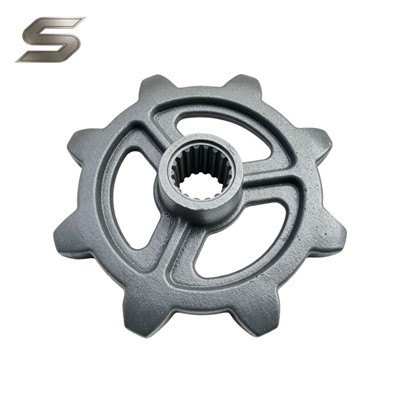
At the end of the day, quality control in centrifugal castings is a mix of science, attention to detail, and years of experience. It’s not about using the fanciest equipment—though we invest in good tools—but about sticking to the basics that prevent defects before they start. If you’re sourcing centrifugal castings for heavy-duty industrial applications, you don’t want to settle for parts that are “good enough.” You want parts that are consistent, strong, and reliable, because when your equipment is down, every day costs you money. For over a decade, my team has built our business on delivering that level of quality to clients across industries: mining, steel, energy, automotive, and more. If you’re working on a project that needs high-performance centrifugal castings, let’s connect to discuss your requirements, go over your specs, and make sure the parts you get are exactly what you need for your operation.
Resin Sand Casting References
- Campbell, J. (1991). Castings (2nd ed.). Butterworth-Heinemann.
- Tiryakioğlu, M., & Campbell, J. (2004). Centrifugal casting: Science and engineering. Journal of Materials Engineering and Performance, 13(6), 727-735.
- Sigma Gear Enterprises. (2018). Centrifugal Casting Quality Control Standards for Industrial Components. Industry Technical Report.
- Steel Founders’ Society of America. (2020). Non-Destructive Testing for Castings: Best Practices and Applications. SFSA Technical Bulletin No. 12.
- Kearns, M. (2015). Stress Relieving of Castings: Processes and Benefits for Industrial Components. International Journal of Metalcasting, 9(3), 45-52.
Hebei Shata Machinery Co., Ltd.
As one of the most experienced centrifugal casting manufacturers and suppliers in China, we have advanced foundry technique and professional production team. Welcome to buy high-grade centrifugal casting for sale here from our factory. All custom made products are with high quality and competitive price.
Address: No.11 Cangshun Rd., Shijiazhuang, Hebei, China
E-mail: Info@shatamachinery.com
WebSite: https://www.shatamachinery.com/
